
Army Chief General Upendra Dwivedi asserted that Operation Sindoor was unlike any conventional mission and that it was akin to playing a game of chess as 'we did not know' what would be the enemy's next move.

The defence ministry on Tuesday approved the procurement of military equipment and weapons worth Rs 28,000 crore that included swarm drones, carbines and bulletproof jackets.
Another major announcement that came was an MoU signed between GE and Hindustan Aeronautics Limited to jointly produce fighter jet engines for the Indian Air Force.
"It is shocking to note that Turkey, the second-largest arms supplier to Pakistan after China, has played a key role in modernising Pakistan's navy and enhancing its aerial warfare capabilities. "This defence collaboration is not just commercial; it is ideological, targeting the stability of South Asia and emboldening Pakistan's military adventurism," SJM national co-convenor Ashwini Mahajan said in a statement.
'Looking at how quickly the hostilities were escalating, the nuclear threshold did not seem that far.'
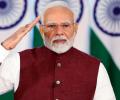
Operation Sindoor has carved out a new benchmark in our fight against terrorism, and has set up a new parameter and new normal. Operation Sindoor is not just a name but a reflection of the emotions of millions of Indians. Operation Sindoor is an unwavering pledge for justice. Terrorists dared to wipe 'sindoor' from the foreheads of our sisters; that is why India destroyed the very headquarters of terror.
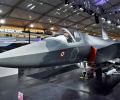
If I were to explain stealth to a layperson, I'd ask them to think of the game chupan-chupai (hide and seek) we played as children, explains Air Commodore Nitin Sathe (retd).

Asserting that India will not tolerate any 'nuclear blackmail', Prime Minister Narendra Modi on Monday said operations against Pakistan have only been kept in abeyance and the future will depend on their behaviour.

John Spencer, the chair of Urban Warfare Studies at US-based think-tank Modern War Institute, said India showcased its ability to strike any target in Pakistan "at will" and drew and enforced a "new red line" for cross-border terrorism under the operation that was launched early on May 7.
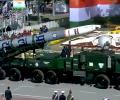
India showcased its indigenous short-range tactical missile Pralay for the first time at the Republic Day parade on Sunday. The missile, developed by the Defence Research and Development Organisation (DRDO), is capable of carrying a nuclear warhead and has a range of 150 to 500 kms. The parade featured an array of other indigenously built missiles, surveillance systems, and weapon systems, reflecting India's growing military prowess. The DRDO displayed its latest innovations for national security, including the quick reaction surface-to-air missile, airborne early warning and control system, and drone detect, deter and destroy system.
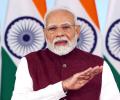
Presenting the full text of Prime Minister Narendra Modi's address to the nation on May 12, 2025, in which he dictated India's new doctrines on countering terrorism.
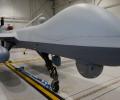
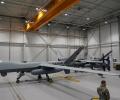
The defence ministry on Thursday accorded its approval to procure 30 MQ-9B Predator drones from the US to crank up the surveillance apparatus of the armed forces, especially along the frontier with China, people familiar with the development said.
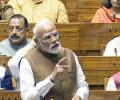
Prime Minister Narendra Modi defended India's actions against terrorism, stating no country stopped India and criticizing the Congress party for not supporting the armed forces. He highlighted the success of Operation Sindoor and warned Pakistan against further misadventures.
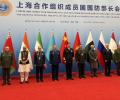
In his address, Singh said there should be "no double standards" in combating terrorism and urged the SCO member nations to condemn the menace with unity.
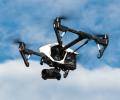
While there were concerns about the security aspect of drones, top government officials were of the view that restricting the drone industry would stifle a sunrise sector which holds significant promise for future, reports Arindam Majumder.
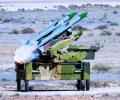
'When one air force (India's) hits the other's airbases with impunity and that air force (Pakistan's) is not able to respond, then the air force, which has put the other's airbases out of commission, has won.'
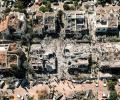
Trump has a major decision to take in coming days -- specifically, how to rescue Israel from the attritional war that lies ahead, points out Ambassador M K Bhadrakumar.

It's a strategic approach in which the country's military and defence mechanisms evolve continuously in tandem with emerging threats. The new strategy anticipates events and prepares to counter those proactively.
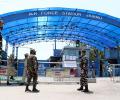
'The fact that this happened and the fact that we were not able to bring it down, we were not even able to trace from where it came from and where it went, certainly raises questions on our level of preparedness.'
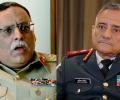
In the wake of the recent hostilities, both sides have moved from weapons to words, with India dispatching several delegations to visit more than 30 capitals across the world. A similar effort by Pakistan is set to start on Jun 2.

Top military officials from India and Pakistan highlighted their views at the Shangri-La Dialogue in Singapore, billed as Asia's premier defence forum, amid heightened tensions between the two sides following last month's military confrontation.

'If UAV technology is used by the adversary to target VIPs or strategic targets it would be a different ball game altogether,' says Group Captain Murli Menon (retd).

'You don't need massive industry or huge energy resources.' 'You could start with just 3 or 4 people in a coffee shop and invent the world.'

"Today there is a government in the country which cannot compromise even on one inch of the country's borders," the prime minister added.

In a year bookended by intractable conflicts and geopolitical fragmentation, India focused on ramping up military prowess by broadly firming up defence procurement worth Rs 4.22 lakh crore even as Indian and Chinese militaries completed pulling back their troops from border face-off points in eastern Ladakh.

'In India, China's capacities to conduct new types of warfare is critically underestimated,' says Claude Arpi.
The sources said the talks are focused on sorting out certain issues relating to cost component, weapons package and technology sharing.

What must India do now?

The world needs to wake up to this new dimension of war at sea and be prepared to face the 'unknown enemy' who have the advantage of attacking at their choice of location and time, cautions Commodore Venugopal Menon (retd).

Manipur experienced a year of intense turmoil in 2024, marked by escalating violence, displacement, and deepening divisions between the Meitei community in the valley and the Kuki tribes in the hills. The conflict, rooted in historical grievances and fueled by political tensions, resulted in numerous casualties, mob attacks, and drone strikes on civilian areas. The situation has led to widespread displacement, fear, and a sense of insecurity among the affected communities, with no signs of peace in sight.
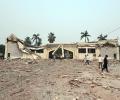
'Every decision India makes along the LoC, it must also consider implications along the LAC.'

Unless each attack drone can be neutralised, India will be literally deploying elephants to stamp out ants -- and the ants may still survive! points out N Sathiya Moorthy.

Easy availability of drones has increased the complexity of security challenges and the Indian military is developing capabilities to effectively deal with the threats, be it from State-sponsored elements or by states themselves, Army Chief Gen M M Naravane said on Thursday.
'Had Haji Pir and/or Skardu been taken, the message would have gone out not just to General Asim Munir and his cohort in the Pakistan army but to the Pakistani people that every terrorist incident in India would lead to substantial loss of territory in PoK.'

'They only bring pieces. Dialogue is the only way forward.' 'We should get people who have influence to bring the community leaders to sit across the table and talk.' 'Otherwise, our adversaries across the borders will add fuel to the fire. Let's not give them a chance.'

The Global Hawk can carry out surveillance of a stretch of land or ocean for over 30 hours continuously, physically scanning up to 100,000 sq km each day.

Addressing an event in New Delhi, Gen Pande also said the recent global developments have underscored that the security of the nation can neither be outsourced nor be dependent on the largesse of others.

The rocket which fell on the compound of former chief minister Mairembam Koireng's residence seemed to be an improvised one.

Everybody talks of China as the real threat, but we aren't even building a decisive capability against Pakistan, asserts Shekhar Gupta.
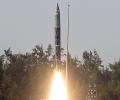
Ahead of Republic Day, the Indian Army announced on Thursday the addition of two new features to this year's parade: battlefield surveillance systems and a Defebce Research and Development Organisation tableau showcasing Pralay, short-range ballistic missiles.
